Category Archives: books

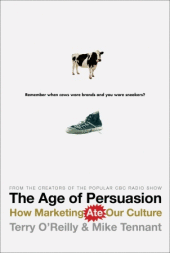
The Age of Persuasion: How Marketing Ate Our Culture

age-of-persuassion-how-marketing-ate-our-cultureOne of my favorite radio shows has been turned into a book. The Age of Persuasion: How Marketing Ate Our Culture is now available in book stores across Canada!

Authors Mike Tennant and Terry O’Reilly have known each other for about 20 years; they began their career together making radio shows in 1995 with O’Reilly on Advertising. They’ve followed that up with “The Age of Persuasion” and a book based on that show which hits bookstores today.

Last Tuesday I took advantage of an opportunity to talk on the phone with Terry and Mike about the show and their new book “The Age of Persuasion: How Marketing Ate Our Culture”. My questions are in bold text.

Read more »

Malcolm Gladwell on The Advantages of Disadvantages

In preparation for the release of his new book, Outliers, next week, Malcolm Gladwell has published an article, The Uses of Adversity, explaining that sometimes disadvantages come with unexpected advantages.

Writing about the piece afterwards, Gladwell expounded the approach that being an outsider, having a disability or coming from a social-economic disadvantage, can sometimes be exactly what one needs to succeed.

From Gladwell’s blog:

If dyslexia can—under certain circumstances—be advantageous, what are other disadvantages that can have the same effect?

In the article, I mention, in passing, the question of class size, and the data on class size is really quite fascinating. Time and time again studies fail to show any significant advantage to reducing the size of classes—except in the case of very poor children in the very earliest of grades.

This, of course, defies common sense. We know that teacher feedback is a big component in learning. So why wouldn’t learning be enhanced by lower teacher: student ratios? One answer might be that large classes are a disadvantage with advantages: that in coping with the difficulty of competing for teacher attention, kids learn something more important—namely self-reliance. This might also explain why the highest achieving schools—those in places like Japan and Korea—tend to have much larger classes than in the United States.

Aside from the many, many variables that might make comparing class sizes across nations and cultures difficult, I also wonder if teachers instructing inconsistently large or small classes might not be changing their styles to meet the particular needs of a particular class size. It stands to reason that one would teach a class of 10 quite a bit differently than a class of 30—however it’s also very understandable that teachers tend to teach the same way from lesson to lesson and stick to it—regardless of class size.

Outliers: Why Some People Succeed and Some Don’t

I’ve been super excited for Malcolm Gladwell’s new book, “Outliers: Why Some People Succeed and Some Don’t”. The release date of November 18, 2008 was just announced on Amazon, as well they’ve got a product description up too:

In this stunning new book, Malcolm Gladwell takes us on an intellectual journey through the world of “outliers”—the best and the brightest, the most famous and the most successful. He asks the question: what makes high-achievers different? His answer is that we pay too much attention to what successful people are like, and too little attention to where they are from: that is, their culture, their family, their generation, and the idiosyncratic experiences of their upbringing. Along the way he explains the secrets of software billionaires, what it takes to be a great soccer player, why Asians are good at math, and what made the Beatles the greatest rock band.

Brilliant and entertaining, OUTLIERS is a landmark work that will simultaneously delight and illuminate.

Here’s a list of writings and talks by and about Gladwell that cover genius/prodigy, education, and working:

Excerpts from ‘Up Till Now’

Up Till NowI’ve grown out of my teenage fandom for all things Trek, but I found these excerpts from William Shatner’s new autobiography, Up Till Now, very interesting. They encompass a range of experiences from his time on Star Trek, where he confesses being the colossal jerk of legend, to his poignant recollections of the death of his third wife.

Honestly, I always assumed he killed her, but now I’m not so sure. Either way, I find this kind of bear-all openess, from a legend such as Shatner, riveting.

torrent

Dooce’s New Book

Heather Armstrong, aka Dooce, just announced the release of the new book she’s been putting together, Things I Learned About My Dad (in therapy). It’s a book of essays by several of her good friends (some of whom I read regularly), about fatherhood from the perspective of fathers, wives, daughters and sons.

I’ve written two of the 17 essays, one about my father and one about Jon. A few weeks ago I gave my father an advance copy of the book with the hope that he would read what I had written, but I didn’t say anything to him other than HERE IS MY HEART AND SOUL, DO WITH IT WHAT YOU WILL. I found out a week later that he had taken it home and used it to prop up a wobbly toilet. I like to think that I improved his life by those two inches.

I’d totally like to pick this one up.

Freakonomics: A Rogue Economist Explores the Hidden Side of Everything

Sumo wrestlers are to teachers as real estate agents are to Ku Klux Klan members—or at least these are a couple of ideas put forth by the book I got for Christmas, “Freakonomics”. The book makes some startling connections between seemingly incongruent situations.

Freakonomics Cover

Economist Steven Levitt and journalist/contributor to the New York Times Magazine Stephen Dubner’s have co-authored this much talked about book from 2005. I’ve been devouring it in my spare time and I’m loving every page. It’s hard to describe exactly what the book is about because the most unifying theme one can identify within it, is that using statistics you can disprove a lot of conventional thinking.

I’m just about finished it, but in the meantime I have also been enjoying some of their other writings, both at the Freakonomics Blog and as guest posters on Google’s Blog. I have to wonder, what would Levitt do if he had access to Google’s information? Seems like there is a whole other book there waiting to be written.

If you enjoyed my previous recommendation of Blink, by Malcolm Gladwell, then I definately think you should check out Freakonomics. Oh, and if you’re interested, the chapter excerpts will give you a little taste as to how sumo wrestlers are similar to school teachers.

Middlesex

I finished the book that Anna left for me to read, “Middlesex” this morning. What a great novel! She sure knows how to pick them.

“‘I was born twice: first, as a baby girl, on a remarkably smogless Detroit day of January 1960; and then again, as a teenage boy, in an emergency room near Petoskey, Michigan, in August of 1974. . . My birth certificate lists my name as Calliope Helen Stephanides. My most recent driver’s license…records my first name simply as Cal.’
So begins the breathtaking story of Calliope Stephanides and three generations of the Greek-American Stephanides family who travel from a tiny village overlooking Mount Olympus in Asia Minor to Prohibition-era Detroit, witnessing its glory days as the Motor City, and the race riots of 1967, before they move out to the tree-lined streets of suburban Grosse Pointe, Michigan. To understand why Calliope is not like other girls, she has to uncover a guilty family secret and the astonishing genetic history that turns Callie into Cal, one of the most audacious and wondrous narrators in contemporary fiction. Lyrical and thrilling, ‘Middlesex is an exhilarating reinvention of the American epic.’”

Winner of the Pulitzer Prize and one of the most realistic seeming fictional books I’ve ever encountered, I highly recommend reading Middlesex.