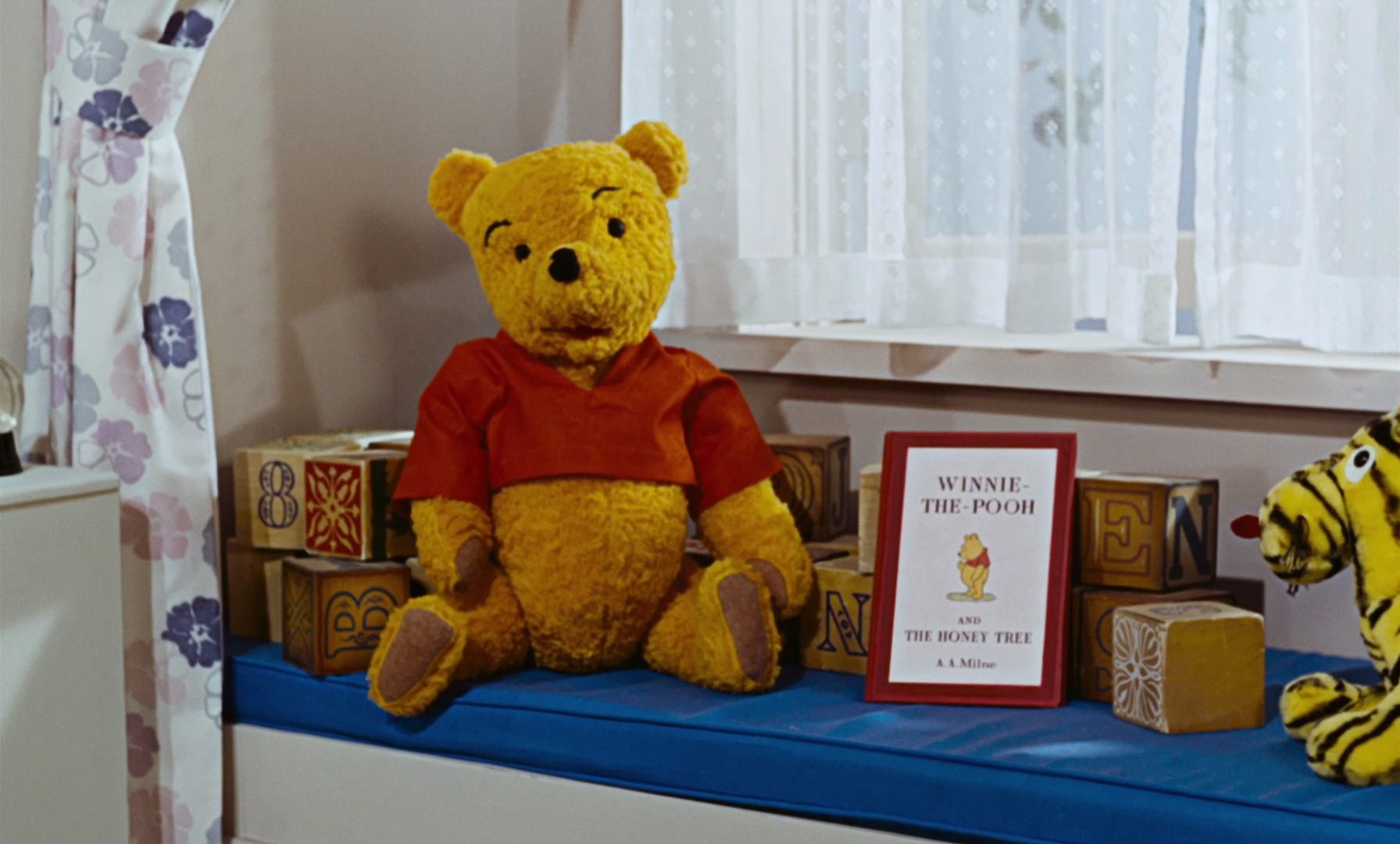
Recall MLA Nathan Neudorf

In the 2023 provincial election, the Lethbridge East Riding had a very close result with Nathan Neudorf ultimately remaining MLA. 1

With what happened in the Legislature the other day, the passing of Bill 2 without debate… Neudorf needs to be held accountable. He voted for this attack on our freedoms. He needs to be recalled.

Update: It appears I’m not the only one that feels this way: https://operationtotalrecall.ca

Update 2: Instead of just complaining, I’m going to do something about it.

  1. Neudorf only won by 636 votes.[]

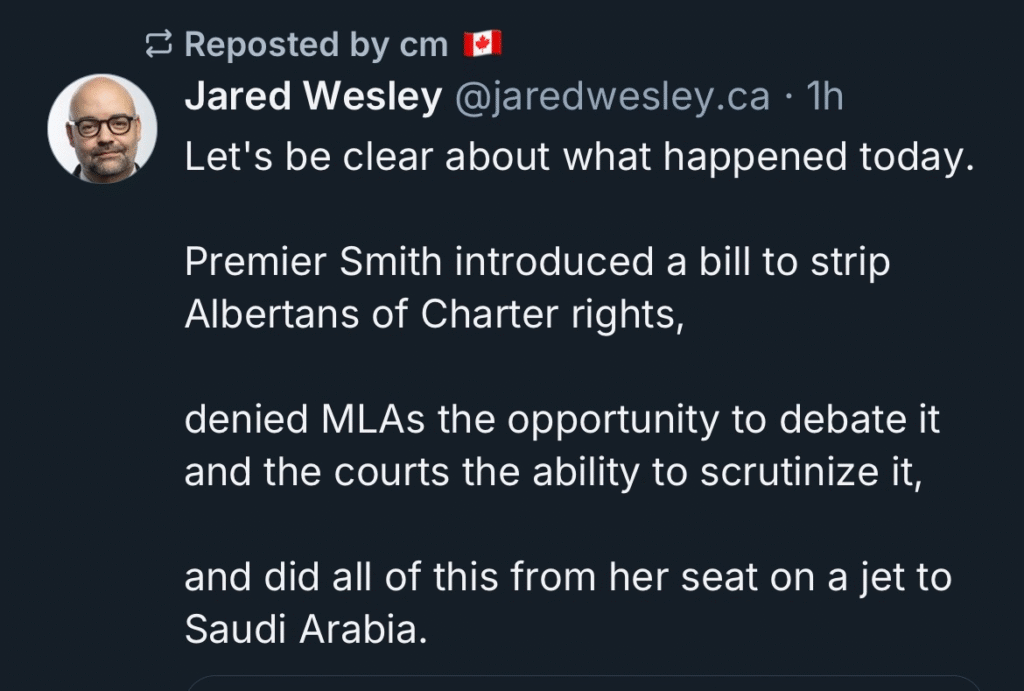
Alberta Uses Notwithstanding Clause to Attack Constitutional Rights and Freedoms

I watched the livestream yesterday as the UCP ruling party voted to take away our constitutionally protected right to collective bargaining and the freedom to gather and strike. I’m livid.

The Alberta Teachers’ Association president, Jason Schilling, shared his thoughts in a news scrum yesterday:

https://youtu.be/Hy1YKLrbGuQ?si=iEeVKSbVv5uwgnKQ

Now that they’ve taken this unprecedented step, what rights will they take away next?

It looks like the Alberta Federation of Labour is preparing a response. If the teachers can’t strike then the unions that are still allowed to strike will take up that mantle. This fight is not over and it looks like it’s going to be ugly.

Apple Sued for Monopoly

Last Thursday the US Department of Justice announced it was suing Apple for monopolizing smartphone markets within the United States. I’ve spent the last few days trying to wrap my head around how much of this is hype and how much is a legitimate public concern?

From the Office of Public Affairs | US Dept. of Justice:

The complaint alleges that Apple’s anticompetitive course of conduct has taken several forms, many of which continue to evolve today, including:

  • Blocking Innovative Super Apps. Apple has disrupted the growth of apps with broad functionality that would make it easier for consumers to switch between competing smartphone platforms.
  • Suppressing Mobile Cloud Streaming Services. Apple has blocked the development of cloud-streaming apps and services that would allow consumers to enjoy high-quality video games and other cloud-based applications without having to pay for expensive smartphone hardware.
  • Excluding Cross-Platform Messaging Apps. Apple has made the quality of cross-platform messaging worse, less innovative, and less secure for users so that its customers have to keep buying iPhones.
  • Diminishing the Functionality of Non-Apple Smartwatches. Apple has limited the functionality of third-party smartwatches so that users who purchase the Apple Watch face substantial out-of-pocket costs if they do not keep buying iPhones.
  • Limiting Third Party Digital Wallets. Apple has prevented third-party apps from offering tap-to-pay functionality, inhibiting the creation of cross-platform third-party digital wallets.

The complaint also alleges that Apple’s conduct extends beyond these examples, affecting web browsers, video communication, news subscriptions, entertainment, automotive services, advertising, location services, and more. Apple has every incentive to extend and expand its course of conduct to acquire and maintain power over next-frontier devices and technologies.

After investigating the top five complaints…

Blocking Innovative Super Apps: Super Apps provide multiple services including payment and instant messaging services, effectively becoming an all-encompassing self-contained commerce and communication platform that embraces many aspects of personal and commercial life. At the same time they are taking Apple to task, regulators in the US and Europe have also expressed concerns about the overall power of the such super apps and appear to be giving mixed signals over their concerns of privacy and monopoly powers.

Suppressing Mobile Cloud Streaming Services: Although Apple originally put up some roadblocks for Microsoft and its Xbox streaming services, it is now allowed on iOS1. Perhaps there are other services of which I’m not aware that apply here, but it sounds like this is an older grievance that has been rectified.

Excluding Cross-Platform Messaging Apps: Although iPhone’s green bubbles have been characterized as the epitome of Apple’s unfairness — reading into the complaint it appears it’s more about the lack of SMS support in public APIs so that other apps can choose to mix their own propriety message protocols with SMS the way iMessage does. I agree, Apple should open up both phone and SMS messaging for third parties.

Diminishing the Functionality of Non-Apple Smartwatches: This complaint boils down again to restrictions on the public API that Apple’s private APIs don’t have. Although I think it’s absurd to say third party smartwatches only run on bluetooth and “Apple recognizes users frequently disable Bluetooth on their iPhone without realizing that doing so disconnects their watch”2 and has therefore allowed syncing to continue with Apple Watch while bluetooth is disconnected. But really… who frequently disables Bluetooth?

Limiting Third Party Digital Wallets: As explained in the briefing, “Digital wallets are apps that allow a user to store and use passes and credentials, including credit cards, personal identification, movie tickets, and car keys, in a single app.” The complaint alleges that if “financial institutions offered digital wallets, then users would have access to new apps and technologies without needing to share their private financial data with additional third parties, including Apple.” I’d rather share my private data with Apple who believes that privacy is a human right vs. the retailers who are notorious for tracking users.

It appears there might be some legitimate monopolistic behaviour even though Apple doesn’t have a 95% monopoly control of the market the way Microsoft did during the case in 1998. I suspect there will be a few concessions but even in that case, in which Microsoft was found guilty, the end result3 was basically a mere settlement promise from Microsoft to straighten up and fly right. The remaining mystery is, even if Apple is found guilty, will the cure actually be worse for consumers?
  1. in select countries[]
  2. emphasis mine[]
  3. after appeals and technicalities[]

Lethbridge police officers temporarily demoted in connection with surveillance of NDP cabinet minister

CHAT News Today

Sgt. Jason Carrier and Const. Keon Woronuk of the Lethbridge Police Service have been temporarily demoted after unauthorized surveillance of Lethbridge West MLA Shannon Phillips and stakeholders in the protections of the Castle region in southwest region.

Carrier was on-duty but on a meal break with two other officers when Phillips entered the Chef Stella Diner to meet informally with stakeholders on the Castle region changes during the morning of April 17, 2017.

Carrier texted Woronuk — who was acting sergeant on duty at the time — with a picture of the meeting and location. Woronuk attended the diner shortly thereafter.

In a conversation between the two uniformed officers as they left the diner after taking photos of the meeting, Woronuk said to Carrier that he, “would hate to see Phillips drive away from the restaurant and there was a reason to stop her,” according to the penalty decision.

In addition to taking photos, Woronuk was involved in setting up surveillance and subsequently following one of the stakeholders while running a police information check on them.

Full article after the jump:
Continue reading “Lethbridge police officers temporarily demoted in connection with surveillance of NDP cabinet minister”

Micro$oft Picks Fight with Mike Rowe

The Software giant is mad because Mike Rowe’s new website http://www.mikerowesoft.com sounds a lot like Microsoft.com. Well boo-hoo. They offered him $10 to buy the domain from him. He said he’d like $10,000 and after they realized their scare tactics weren’t working it sounds like they might actually back off, from ZDnet, “We take our trademarks seriously, but in this case maybe a little too seriously. It’s important to recognize that under the law companies are required to take this type of action to protect their trademark against widespread infringement. But that said, we appreciate that Mike Rowe is a young entrepreneur who came up with a creative domain name. We’re currently in the process of resolving this matter in a way that will be fair to him and satisfy our obligations under trademark law.”

Pooh heirs hire Cochran in Disney suit

Attorney Johnnie Cochran Jr., best known for his work in OJ Simpson’s murder trial, stated last month that he is swearing off criminal law. It was announced today that his newest client is Winnie the Pooh — actually the heirs of the Stephen Slesinger. They allege that Disney owes them millions of dollars because they miscalculated royalties due from the sales of Pooh dolls, books and other merchandise for years. The lawsuit has been going on for the last 12 years, and the Slesinger’s have changed attorneys several times in that time.

Pati Slesinger stated, “We are honored to have Mr. Cochran […] on our team.” Stephen Slesinger, Pati’s father, acquired the rights to Pooh from British author A.A. Milne in 1930 and expanded them in a 1932 agreement.

Update: A legal opinion on the case was delivered December 21, 2012.

In 1930, A.A. Milne transferred to Slesinger exclusive merchandising and other rights to Winnie-the-Pooh works in the U.S. and Canada. In 1961, Slesinger exclusively “assigned, granted, and set over to” Disney the rights in the 1930 agreement. A 1983 agreement sought to resolve the parties’ disputes, but Slesinger contends it retained rights in the works, while Disney maintains Slesinger assigned all rights. In 1991, before the present litigation, Slesinger sued in state court, alleging breach of the 1983 agreement. Slesinger acknowledged that the 1983 agreement “regranted, licensed and assigned all rights” to Disney. The action was ultimately dismissed. The dispute continued in federal court. The district court dismissed, noting that the parties’ actions indicated the rights were transferred to Disney in the 1983 agreement. Between 1983 and 2006, Disney registered at least 15 trademarks. In 2004, Disney registered copyrights in 45 works and renewed copyright registrations for another 14. Slesinger did not attempt to perfect or register trademarks or copyrights before asserting its federal claims and never objected to Disney’s registrations until 2006, when the state court dismissed its claims and Slesinger attempted to cancel Disney’s applications and marks. The Federal Circuit affirmed the Board’s dismissal, citing estoppel.

Don’t Fear Fellow Downloaders

The following article was copied from the National Post in October 2003. It details one lawyer’s opinion as to why it is legal for Canadians to copy music off the Internet. I would have linked to it instead of copying it down, but I couldn’t find a link anywhere, so here it is:

Why downloading is legal

We already pay for the right to copy music off the Web
COREY BERGSTEIN

I download music from the Internet. I do this without the permission of the owners of the copyrights in either the composition or the recording. I’m not afraid to admit I do it all the time. That’s because there is nothing illegal about what I am doing.

Copying music for the purpose of private use is legal in Canada.

What? you exclaim. The debate over copying music came to a head in the mid 1990s when the Canadian music industry stepped up its complaints that people were getting rich off the practice. Bootleggers? Street Vendors? Black Marketeers? No. The music industry’s targets were Maxell, Fuji, TDK, Sony and all the other companies that make the cassette tapes on to which the music was being copied, with the even greater threat of CD-Rs (recordable CDs) just over the horizon.

So the Canadian government stepped in and granted the music industry’s wish for a levy on Blank Audio Media. Through the levy, we all pay a little bit more for our blank tapes and CD-Rs and the extra funds are distributed to artist members of the various Canadian music industry collectives, such as the Canadian Musical Reproduction Rights Agency (CMRRA) and the Society of Composers, Authors and Music Publishers of Canada (SOCAN).

However, Parliament could not impose a levy (a kind of tax) based on a premise of illegal activity. So, in 1998, simultaneously with the imposition with the levy, the Canadian Copyright Act was amended to provide for the express exclusion of copying for private use from being an infringement of copyright.

That exclusion is now found in section 80 of the Copyright Act and reads, in part: 80(1) Subject to subsection (2), the act of re- producing all or any substantial part of …(c) a sound recording in which a musical work …is embodied, onto an audio recording medium for the private use of the person who makes the copy, does not constitute an infringement of the copyright in the …sound recording.

Let’s look at these sections. The first part of 80(1) is concerned with reproducing a sound recording onto an “audio recording medium.” Since the levy only applies to audio recording media, the exception only applies to copies recorded onto an “audio recording medium.”

Section 79 of the Copyright Act defines “audio recording medium” as “a recording medium, regardless of its material form, onto which a sound recording may be reproduced and that is of a kind ordinarily used by individual consumers for that purpose…”

The Canadian Copyright Board, which is responsible for authorizing the amount of the levy, has stated that the term “ordinarily” is used to describe what is ‘regular, normal, average, recurring or consistent’. It goes on to state that “the levy is applicable to recording media, which a non-marginal number of consumers use for private copying in a way that is not marginal.” Well, this obviously covers such media as cassette tapes and blank CDs, but is a computer’s hard drive an “audio recording medium?” Well, no levy is currently imposed against computer hard drives. However, when I download a song from the Internet to my computer, I am physically altering my hard drive with a representation of the sound recording. I may not be able to see this alteration with the naked eye, but that does not change the fact that a physical change occurs. Additionally, I argue that members of the public “ordinarily” use their hard drives to copy music. Simply because no levy is imposed on hard drives doesn’t remove such media from inclusion in the construction of section 80. So, now that I know that I am reproducing a sound recording on to an audio recording medium’ the question remains whether I am doing so for my “private use.”

A private use is one that is made for my personal musical benefit and includes such uses as sitting at home listening to it play on my stereo or on my computer or burning it to a compact disc and playing it in my car for my own personal enjoyment. In contrast, public uses would include playing it in my restaurant or nightclub or burning multiple copies and selling them on the street, none of which I do.

But aren’t the Internet sources just illegal copies? No. Not when Parliament intentionally refused to impose the requirement that the source or target be lawfully owned — a fact confirmed by the Copyright Board.

As a result, when I download music from the Internet, I am making a copy of a sound recording on an audio recording medium for my own private use. As such, section 80(1) of the Copyright Act deems my copying not to constitute an infringement of copyright.

This does not end the section 80 analysis. Parliament was concerned that permitting private copying would lead to the condoning of undesirable conduct. To ensure that we all behave ourselves, the amendments to the Copyright Act included section 80(2) which reads, in part: 80(2) Subsection (1) does riot apply if the act described in that subsection is done for the purpose of doing any of the following …(with the sound recording), (a) selling or renting out …; (b) distributing, whether or not for the purpose of trade; (c) communicating to the public by telecommunication; or (d) performing, or causing to be performed in public.’

Section 80(2) addresses the in- tent or the purpose for making the copy and excludes certain public intents or purposes from the beneficial protection provided by section 80(1). The key word to focus on in this section is “the”. This section provides that if “the” purpose of making the copy is one of the listed prohibited purposes, then the protection provided by section 80(1) does not apply. I note that it doesn’t say “a” purpose. It doesn’t say “one” purpose. It says ‘the” purpose. As such, Parliament intended that the listed purpose must be the only purpose for making the copy, or at least, it must be the primary purpose for making the copy, be- fore the section can be applied to exclude the copying from the benefits of section 80(1).

Now, let’s look at the public purposes listed in section 80(2). The first is selling or renting the sound recording. I can honestly state I have no interest in selling or renting the sound recordings I download. You won’t find me on the street corner hocking bootleg copies of Bat Out Of Hell or as the proprietor of SoundBuster Music Warehouse. None of my purposes are covered by this first listed public purpose.

The second listed public purpose is “distributing” the sound recording, whether for trade or not (i.e., by sale or gift). The only action that I am taking in this regard is permitting the sound recording file to be downloaded to my Shared Folder from which location others may copy the sound recording. The third listed public purpose is “communicating to the public by telecommunication.” While currently under consideration by the Supreme Court of Canada, it has been held by the Federal Court of Canada that a communication to the public by telecommunication occurs when any member of the public uses a browser to access a work from a source computer.

A work is communicated to the public, even if transmitted only once, when it is made available to, the public on a site accessible to a segment of the public at different times of their choosing.

Finally, the fourth listed public purpose is performing the sound recording in public, not playing it to friends at my house.

Since my acts of downloading music from the Internet are covered by the beneficial protection from infringement set out in section 80(1) and since they are not covered in the limitations found in the public purposes set out in 80(2), I have shown that my actions are not infringements of copyright.

So, I can download music from the Internet for my own private use and not infringe on the copyright owner’s right to prohibit the unauthorized copying oft his work. Great. However, that does not end the analysis. The right to control copying is not the only right granted by the Copyright Act. Among other rights, the Copyright Act also grants the copyright owner the sole right to control the communication of the work to the public by telecommunication.

By leaving files in my Shared Folder, I may be considered to be communicating those files to the public by telecommunication. However, I solve this problem by removing any copyrighted files from my Shared Folder immediately after downloading them. As such, I cannot be said to be communicating them to the public. Thus, I am not infringing on any other right granted to the copyright holder by the Copyright Act.

So, don’t fear, fellow downloader, downloading music from the Internet for your own enjoyment is legal in Canada. Don’t let the Canadian Musical Reproduction Rights Agency, the Recording Industry Association of America, the boys in Metallica or anyone else intimidate you into believing otherwise. Just tell them that it is perfectly legal and that you’ve already paid for it when you bought that last spindle of blank CD-Rs.

Financial Post
bergsteins@interlog.com
Corey Bergstein practices intellectual property law in Toronto