Time Traveller’s Cheat Sheet

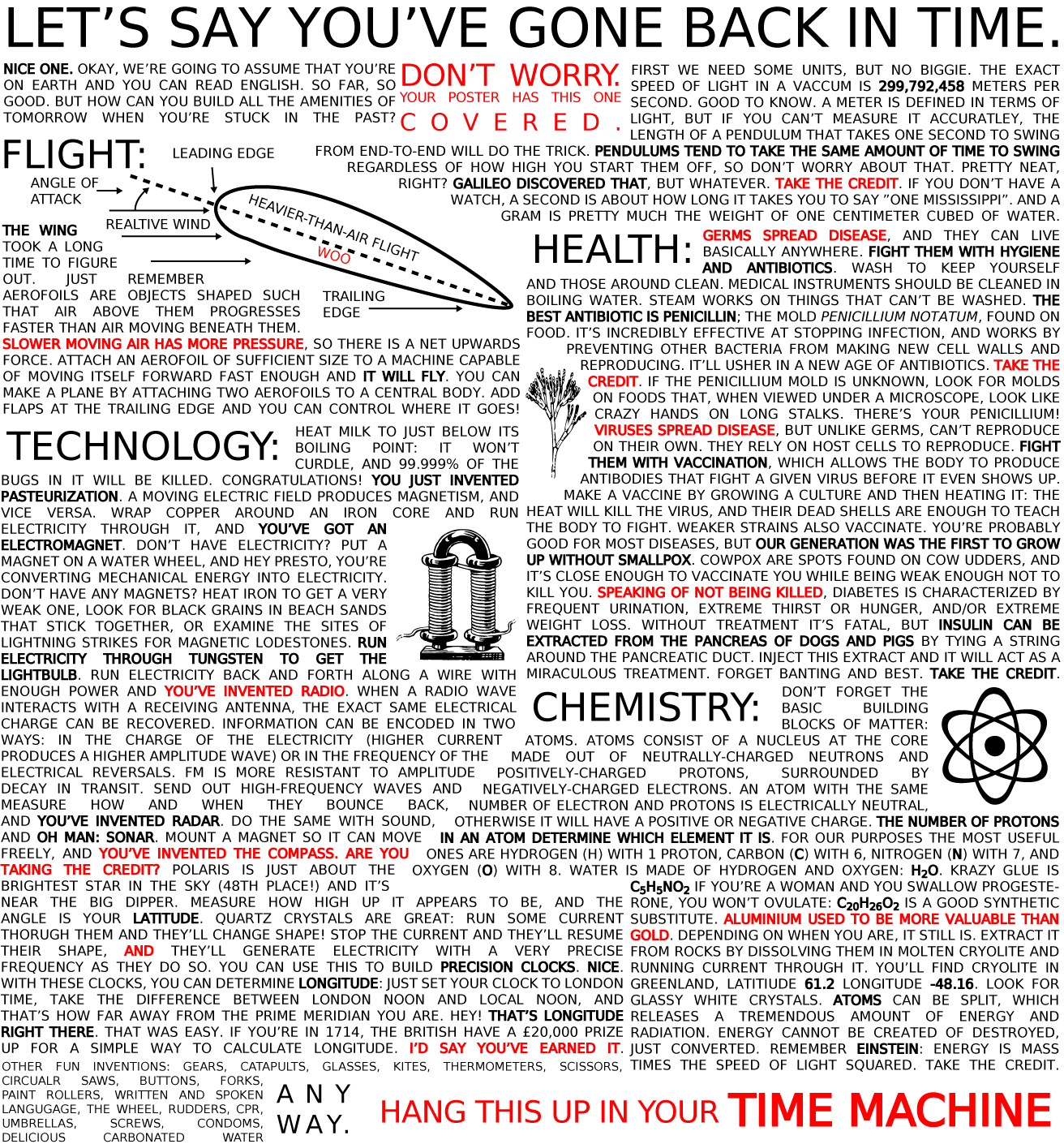
Time Traveller's Cheat SheetImagine you’ve gone back in time, but you’re hankering for a few of the amenities you’ve grown accustomed to living in the 21st century. Hopefully you remembered to bring your Time Traveler’s Cheat Sheet, a handy guide to inventing some of life’s essentials.

A moving electric field produces magnetism, and vice versa, wrap copper wire around an iron core and run electricity through it, and you’ve got an electromagnet. Don’t have any electricity? Put a magnet on a water wheel, and put your copper-wrapped iron beside the wheel, and hey presto, you’re converting mechanical energy into electricity.

Bicycle Built for 2000

In 1962, the IBM 704 became the first computer to sing. The song was Daisy Bell. John Kelly and Carol Lockbaum programmed the vocals and the accompaniment was programmed by Max Mathews. This performance was the inspiration for the famous scene in 2001: A Space Odyssey in which the HAL 9000 computer sings the song as it is deactivated.

In 2009, the song has been recreated using 2000 clips of human voices collected via Amazon’s Mechanical Turk. Workers were asked to listen to a short clip of the 1962 recording and then prompted to repeat the sound as best they could.

See the Bicycle Built for 2000 project page for an interactive look at each sound clip.

Married to the Eiffel Tower

Married to the Eiffel tower is a BBC documentary about objectophilia, a pronounced sexual desire toward particular inanimate objects.

Erika La Tour Eiffel, like Eija-Riitta Berliner-Mauer – the woman who married the Berlin Wall, is an “objectum sexual”, people who fall literally in love with buildings and objects. They have sex and relationships with them; their passion as ardent as any human relationship.

The documentary subjects discuss sexual fantasy with objects throughout the documentary so use your discretion. This is part 1 of 7.

Hit play or watch Married to the Eiffel Tower on Youtube.

Part 2, part 3, part 4, part 5, part 6, part 7.

Thirty Meter Telescope

Last night I went to hear Dr. Luc Simard speak about the new Thirty Meter Telescope that is in development. This telescope will have a 30-metre diameter primary mirror and will provide nine times the collecting area of today’s largest optical telescopes. It will enable scientists to observe objects nine-times fainter than existing 10 metre telescopes in an equal amount of time.

The Thirty Meter Telescope will give astronomers the clearest and deepest picture of the Universe ever. This telescope will push the frontier of technology, fully integrating the latest innovations in precision control, segmented mirror design, and adaptive optics to correct for the blurring effects of Earth’s atmosphere. When combined with the unprecedented light-collecting area of the primary mirror, TMT will be the most capable and sophisticated telescope ever constructed.

Relative to the Hubble Space Telescope, TMT will have 156 times the collecting area and more than a factor of 10 better spatial resolution at near-infrared and longer wavelengths.

The University of Lethbridge is contributing to the project, and my friend, Richard Querel, does some pretty interesting research as part of the team headed by Dr. David Naylor. They have developed a very powerful laser device which calculates atmospheric conditions and can be used to calibrate the telescope to compensate for things like humidity and smog.

Thirty Meter Telescope

See a video fly through of the proposed TMT facility which will be built in either Chile or Hawaii and should be operational by 2018.
Subliminal Ringtones

I can’t express the level of skepticism I feel over this Discovery Channel clip claiming that subliminal ring tones can affect the way our minds think and even the way our bodies grow.

Hideto Tomabechi made headlines in June 2005 when he started selling a ring tone that he claims could make a woman’s breasts grow larger just by listening to it.

If ring tone breast enhancement smacks of gimmickry, the theories behind it are taken very seriously indeed. Over the last ten years, Dr. Tomabechi has been lecturing on how to apply his mind manipulating techniques to the threat of terrorism.

His services have been in demand ever since March 1995 when members of the Aum Shinrikyo doomsday cult released a nerve gas called sarin into the Tokyo Subway System which injured 5000 people and killed 12. Dr. Tomabechi was asked by the Japanese police to deprogram some of the brainwashed members of the cult by applying his “sound” theories.

Hit play or watch at YouTube.

For the record, there have been no scientific studies which demonstrate anything remotely close to subliminal commands influencing motives. It all boils down to the fact that subliminal messages designed to change behaviour DO NOT WORK.

(via)

Gizmo!

About 15 years ago, my cousin Mike got a copy of the movie Gizmo! for Christmas. He raved about how hilarious is was, but it was in black and white and released in 1977; I was skeptical.

Gizmo! is a documentary about some of the thousands of inventions that did things we never thought needed doing, or in ways we never considered doing them. A respectful, yet humorous tribute to the inventors whose vision, however far-reaching, was just a little off the mark.

After watching it, our whole family fell in love with it and to this day, my dad still occasionally impersonates Cecil from the first scene. “I don’t know, but I’ll try!”

Here is Gizmo!, embedded for your own viewing enjoyment.

Hit play or watch Gizmo! at YouTube.

Sine-wave Speech

First developed by Robert Remez and Philip Rubin at Haskins Laboratory, Sine-wave speech is a form of artificially degraded speech. Much like the “aha” moment one gets when one listens to music backwards with a suggested lyric showing, the sine-wave speech is easily recognizable once the listener has been primed.

Listening to the sine-wave speech sound again produces a very different percept of a fully intelligible spoken sentence. This dramatic change in perception is an example of “perceptual insight” or pop-out. We have argued that this form of pop-out is an example of a top-down perceptual process produced by higher-level knowledge and expectations concerning sounds that can potentially be heard as speech.

I picked up on a few of the lines without checking first, and it got easier as I went along.

Try the examples yourself at Sine-wave speech.

(via)