
I came across these beautiful— images and videos of auroras taken from the International Space Station.
I’m thinking this particular aurora video must be a simulation, but either way, WOW.
A collection of digital wonders and some other stuff.
I came across these beautiful— images and videos of auroras taken from the International Space Station.
I’m thinking this particular aurora video must be a simulation, but either way, WOW.
A couple of years ago I mentioned NASA’s Stardust mission and their special dust collecting material, aerogel. Aerogel is a silicon-based solid with a porous, sponge-like structure in which 99.8 percent of the volume is empty space.
Well the Stardust mission has returned and as the New York Times explains, the Stardust mission has exceeded expectations.

I’m somewhat of a science junky and this morning I just discovered a new repository of science related blogs:ScienceBlogs.com.
ScienceBlogs is the web’s largest conversation about science. It features blogs from a wide array of scientific disciplines, with new voices coming on board regularly. It is a global, digital science salon.
The blog topics include everything from ethics to principles of uncertainty.
New Scientist put out an article outlining 11 steps that you can take to improve your brain. I might be a little skeptical of any panacea like pills, but some of their tips seem downright inspired. From the article:
It doesn’t matter how brainy you are or how much education you’ve had—you can still improve and expand your mind. Boosting your mental faculties doesn’t have to mean studying hard or becoming a reclusive book worm. There are lots of tricks, techniques and habits, as well as changes to your lifestyle, diet and behaviour that can help you flex your grey matter and get the best out of your brain cells. And here are 11 of them.
Here is a cool optical illusion where an angry man and a calm woman appear to switch places when you view them from far enough away. It’s something you have to see to believe. Apparently it also works when scaled in Photoshop or printed on paper.
(via BoingBoing)

Since it doesn’t look like the flying cars are on their way, what about personal helicopters? $31,000 will buy you the GEN H-4, a modern marvel that can go nearly 100 kph (aprox. 60 mph). See the GEN H-4 demonstration video. (2.6MB wmv)
(via Cooltools)
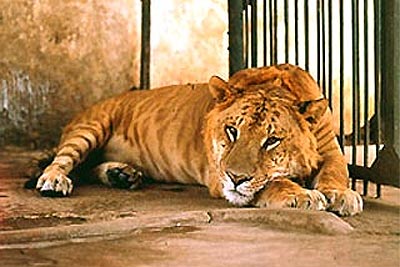
Everybody loves the previous liger image, (I get many people coming to my site for it), so just for the fun of it — here is another one.
I discovered another pummelling essay destroying Intelligent Design. This one is good because it not only lays out the “evolution” of the Intelligent Design camp, but also explains the science behind evolution in a way that any astute reader would be able to understand.
It’s nice and thorough with about six long but fascinating pages – so set aside some time if you’re going to read it.
The Washington Post on the proof behind evolution and the Evolution / Intelligent Design (ID) case in Harriburg, Pa.
“When scientists announced they had determined the exact order of all 3 billion bits of genetic code that go into making a chimpanzee, it was no surprise that the sequence was more than 96 percent identical to the human genome.”
The chimpanzee genetic information let scientists put the very theory of evolution to some tough new tests and the predictions made under the theory passed.
Today a Federal judge in Harrisburg, Pa. USA, will begin to hear a case that asks whether Intelligent Design or other non-scientific explanations should be compulsory teaching material in a biology class.
But the plaintiffs, who are parents opposed to teaching ID as science, will do more than merely argue that those alternatives are weaker than the theory of evolution.
They will make the case — plain to most scientists but poorly understood by many others — that these alternatives are not scientific theories at all.
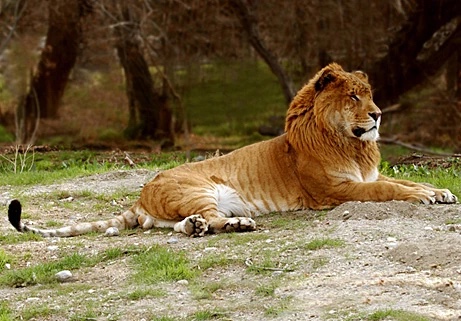
Here is an actual liger!
“It’s pretty much my favorite animal. It’s like a lion and a tiger mixed… bred for its skills in magic.”
-Napoleon Dynamite
The cub is a cross between the female Bengalese tiger and an African lion. The animal resembled a lion cub except that it had stripes, and has been dubbed a “liger”, the Russian Information Agency Novosti reported.
“This was not the result of a scientific experiment,” Novosti quoted zoo director Rostislav Shilo as saying. “It’s just that the lion and the tiger live in neighboring caves in the Novosibirsk zoo, and got used to each other. It’s practically impossible in the wild.”
Here is another liger image.