MagLev Toy Train

A crash course on the amazing properties of super-conductors, the following video demonstrates what may be the future of transportation.

[MagLev Toy Train – Liveleak]

Popular Science published an article five years ago on the possibility of a trans-Atlantic maglev train that would travel in an airless underwater tunnel at 4,000 MPH and make the trip from New York to London in an hour.

A 4,000-mph magnetically levitated train could allow you to have lunch in Manhattan and still get to London in time for the theater, despite the 5-hour time difference. It’s not impossible: Norway has studied neutrally buoyant tunnels (concluding that they’re feasible, though expensive), and Shanghai is running maglev trains to its airport. But supersonic speeds require another critical step: eliminating the air — and therefore air friction — from the train’s path. A vacuum would also save the tunnel from the destructive effects of a sonic boom, which, unchecked, could potentially rip the tunnel apart.

(Via Waxy)
Astro-09 High Altitude Photos

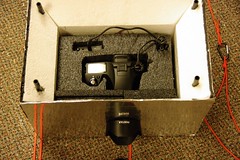
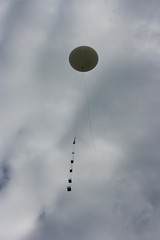
Balloon and payloads just after launchThe following photos are from a set taken with a Pentax k10d from a high-altitude sounding balloon during an experiment conducted by Oklahoma State University while testing a new cosmic radiation detector.

According to the original poster, the k10d performed flawlessly in the harsh vacuum of space at temperatures below -60F.

Balloon and payloads just after launchPentax k10d in impact protection box prior to flight104,000 feet above earth

“The payloads are attached to a sounding balloon which climbs to over 100,000 ft. The balloon is tracked with GPS telemetry systems. When the balloon is launched, it is about 12 ft. in diameter. At peak altitude it is between 40-50 ft. in diameter before burst (or commanded cut-down).”

(via)

Teaching of Psychology

Tom Stafford, a member of the Adaptive Behaviour Research Group in the Department of Psychology at University of Sheffield, recently presented the keynote speech at the annual conference of the Association for the Teaching of Psychology at Lincoln in the UK. He talked a little bit about the priming that can occur when you load up my backmasking site. He was kind to present the topic using this slide.

Thanks Tom! you made my day.

Research Digest wrote up an interesting summary of Tom’s keynote talk.

Milgram’s Experiment on Obedience

Stanley Milgram’s famously unethical but ever so interesting experiment on obedience:

The Milgram experiment was a seminal series of social psychology experiments conducted by Yale University psychologist Stanley Milgram, which measured the willingness of study participants to obey an authority figure who instructed them to perform acts that conflicted with their personal conscience. Milgram first described his research in 1963 in an article published in the Journal of Abnormal and Social Psychology, and later discussed his findings in greater depth in his 1974 book, Obedience to Authority: An Experimental View.

The experiments began in July 1961, three months after the start of the trial of Nazi war criminal Adolf Eichmann in Jerusalem. Milgram devised the experiments to answer this question: “Could it be that Eichmann and his million accomplices in the Holocaust were just following orders? Could we call them all accomplices?”


[Milgram Study of Obedience 1/5 – YouTube]

I didn’t have time to watch the whole thing, but apparently magician/hypnotist Derren Brown reproduced Milgram’s obedience experiment (watch on YouTube). At first I felt confused as to how he got around the ethical violations intrinsic to proceeding with such an experiment in this day and age—but then I realized scientific researchers have ethics boards to get passed; TV producers don’t.

Amazing Audio Illusion

Play this audio clip again after it finishes and hear it continue to “creep up”.

See Wikipedia’s entry on Shepard Tone for the full scoop.

A Shepard tone, named after Roger Shepard, is a sound consisting of a superposition of sine waves separated by octaves. When played with the base pitch of the tone moving upwards or downwards, it is referred to as the Shepard scale. This creates the auditory illusion of a tone that continually ascends or descends in pitch, yet which ultimately seems to get no higher or lower.