The Oscar nominations were just announced. Best picture nods go to The Curious Case of Benjamin Button, Frost/Nixon, Milk, The Reader, and Slumdog Millionaire. More after the jump.
NFB Online!
The National Film Board finally went online today. Canadian classics like The Log Driver’s Waltz, The Cat Came Back, and Neighbours are now in reach of the people they were created for, Canadians! (you other folks from around the world are welcome too).
They’ve included links to various social networking bookmark sites and enabled embedding. Here’s a 2008 movie by Murray Siple, Cart of Darkness, about “a group of homeless men in North Vancouver who’ve married their love of shopping-cart racing with their business of bottle picking.” (NSFW for language).
They still have some kinks to work out, like the embed code linked to the wrong video and it isn’t standards compliant by default (nobody else does that yet either) — but in general it looks like they’re on the right track.
Writer’s Praise Barack Obama’s Inaugural Address
A collection of writers, including my favourite, Malcolm Gladwell, offer praise to the power and poignancy of Barack Obama’s inaugural address in this worthwhile LA Times article
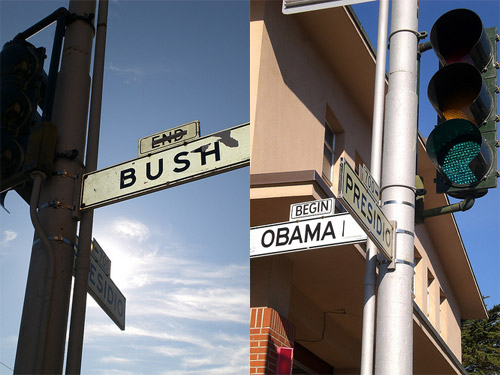
Also, San Fransisco’s Bush Street gets an update:
Stomp
Last night I attended Stomp in Calgary at the Jubilee Auditorium with Kelli and her parents. It was pretty amazing to see and hear the variety of rhythm and music composed from the sounds of brooms, chairs, PVC piping, and match boxes, just to name a few. The biggest surprise came when I began to realize it’s as much a visual narrative as it is about the sound.
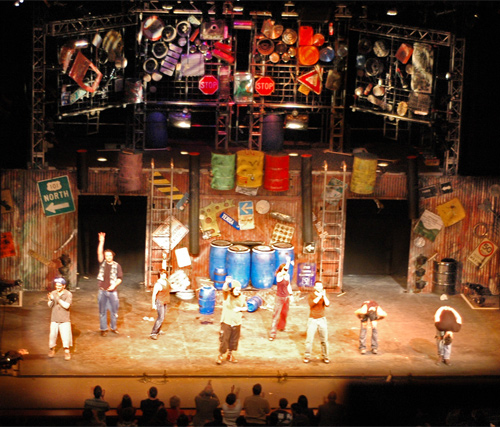
Here is my sneaky snap shot that I took at the end of the show (photographs are discouraged). I assume it’s because flashes and LCD screens are distracting, so I made sure to turn both off.
Backwards Beethoven
Not exactly backmasking, but close enough. A video of classical music being played… but backward:
https://web.archive.org/web/20100811022744/http://pandasmash.com/video.php?epi_id=131
[Backwards Beethoven – Revver]
Why Men Don’t Write Advice Columns
(Another joke I received via email)
Dear Larry,
I hope you can help me here. The other day I set off for work leaving my husband in the house watching the TV as usual. I hadn’t gone more than a mile down the road when my engine conked out and the car shuddered to a halt. I walked back home to get my husband’s help. When I got home I couldn’t believe my eyes. He was in our bedroom with a woman, our next door neighbour.
I am 32, my husband is 34, and we have been married for twelve years.
When I confronted him, he broke down and admitted that they had been having an affair for the past six months. I told him to stop or I would leave him. He was let go from his job six months ago, and he says he has been feeling increasingly depressed and worthless. I love him very much, but ever since I gave him the ultimatum he has become increasingly distant. He won’t go to counselling and I’m afraid I can’t get through to him any more.
Can you please help?
Sincerely, Jane
Response
Dear Jane:
A car stalling after being driven a short distance can be caused by a variety of faults with the engine. Start by checking that there is no debris in the fuel line. If it is clear, check the vacuum pipes and hoses on the intake manifold and also check all grounding wires. If none of these approaches solves the problem, it could be that the fuel pump itself is faulty, causing low delivery pressure to the carburetor float chamber.
I hope this helps.
Larry
The Remnants
The Remnants is a post-apocalyptic comedy written and directed by John August and stars Justine Bateman, Michael Cassidy, Ben Falcone, Ze Frank, Ernie Hudson, and Amanda Walsh. It’s now available in it’s full length version: The Remnants.
Shot during the WGA strike in February 2008, it’s unlikely that this brilliant work will ever be anything more than a pilot.
For the past few months, the pilot has been shopped around to advertisers and other possible sponsors, but given the economy and my schedule, it’s looking unlikely that a confluence of money and time will lead us to shoot more. So I wanted to let people see it, particularly because it features some actors who should be on more lists. Including Ze Frank, who is now an Angeleno.
The web series business model has proved tough for everyone to figure out. Yes, Joss Whedon’s Dr. Horrible was fantastic, but even that couldn’t get the ad sponsors it should have. Selling through iTunes is an option for someone with Whedon’s name brand, but I don’t see it working for The Remnants, even given the recognizability of some of the cast members.
I retained rights to do other things with The Remnants, so I certainly may come back to it at some point in some other form.
Check it out.
Pork and Beans (alternate version)
NBA Team Heat Maps
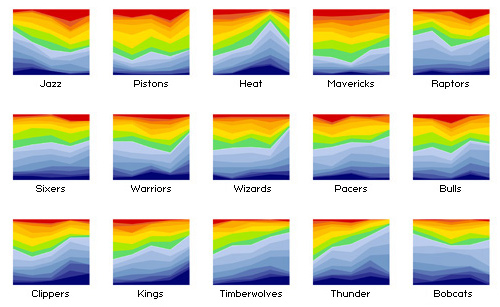
Heating up or cooling down? Obsessionism.com graphs NBA teams by their last five years of stats. This appears, at first glance, to be a pretty good indication of how the teams will do this year.
The Bad Review Revue
Bedtime Stories: “Bedtime Stories is not my cup of tea. Even the saucer. Fairness requires me to report, however, that it may appeal to, as they say, ‘kids of all ages.'” – Roger Ebert, Chicago Sun-Times
The Unborn: “About the only thing here that will haunt your dreams is the film’s final scene, which conveniently portends a sequel, something along the lines of “‘The Born: Jumby’s Revenge’. Now there’s true terror, my friends.” – Glenn Whipp, Los Angeles Times
Bride Wars: “If anyone asks you if you want to see Bride Wars, remember the right answer: I don’t.” – Connie Ogle, Miami Herald
Not Easily Broken: “The movie sinks beneath a great mass of clich’s until the audience has no choice but to wearily raise its hands in surrender.” – Jason Heck, Kansas City Star
Saw V: “It’s not a good sign when watching someone stick their hand into a table saw is easier than listening to them recite dialogue.” – Sam Adams, LOS ANGELES TIMES
Seven Pounds: “It’s like if The Empire Strikes Back opened with Darth Vader taking a paternity test. And once you know “or at least suspect” both what Smith’s cryptic plan is and what the film’s title refers to, there’s little else compelling about this sluggish, self-righteous downer.” – Kevin Williamson, JAM! Movies