In lesson three, John asks us to overlay our drawings on top of Preston Blair’s and identify differences. Here are mine:
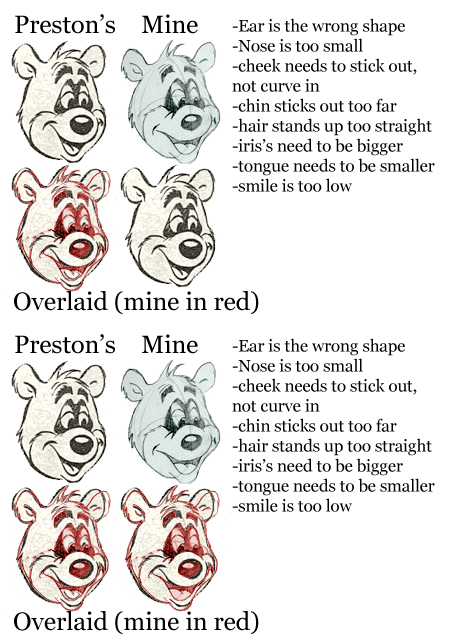
Any other inconsistancies that I missed?
A collection of digital wonders and some other stuff.
In lesson three, John asks us to overlay our drawings on top of Preston Blair’s and identify differences. Here are mine:
Any other inconsistancies that I missed?
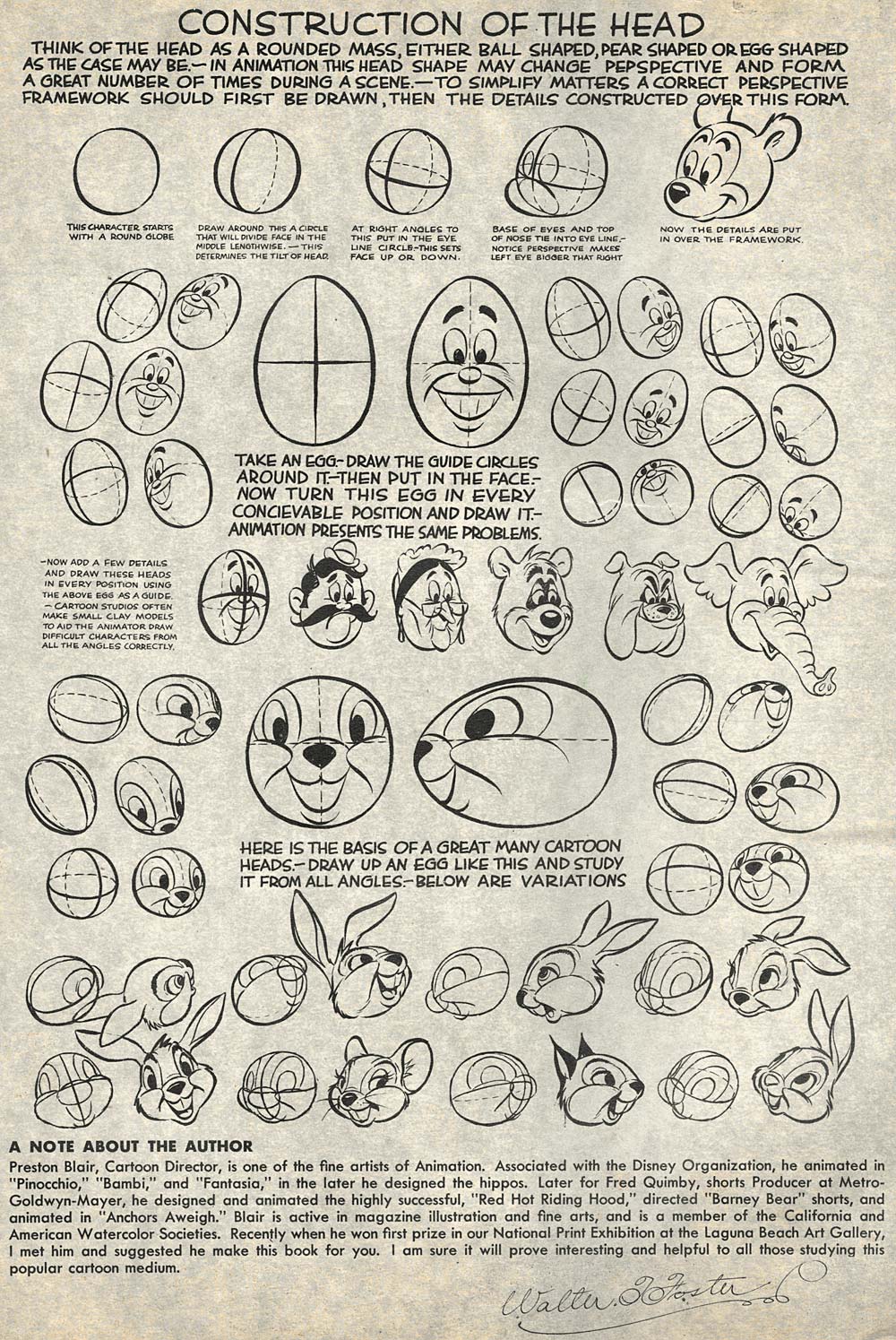
Here are some different angles of the bear from the first page of Preston Blair’s book. I did this set this morning and I’m going to start lesson three this afternoon.
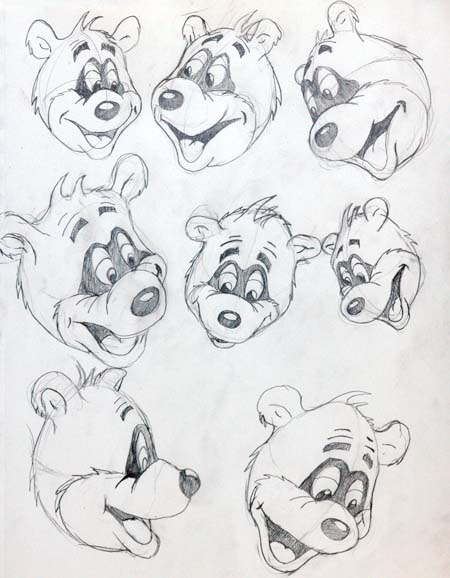
Here are some more drawings in an attempt to improve my cartooning ability. Compare these with the lesson page.
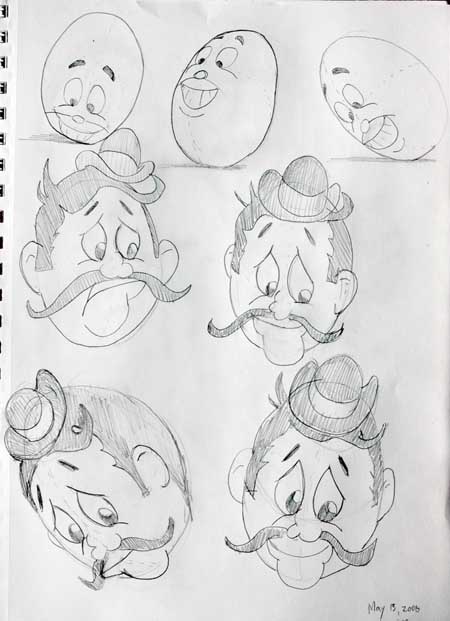
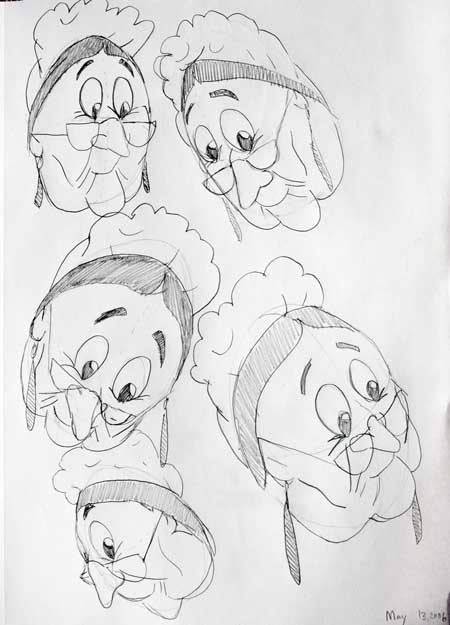
What I find so rewarding about these particular drawings, is that instead of looking at an original image in any given pose and replicating it (something I feel fairly confident at doing), here I am taking an original pose and changing it into other poses—it creates a stronger feeling of ownership even though they aren’t my characters.
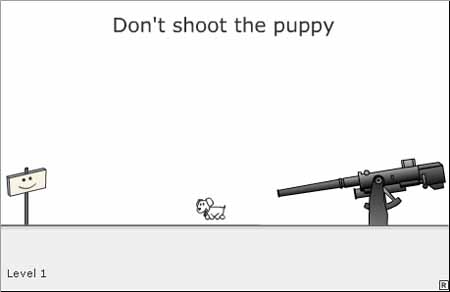
Don’t Shoot the Puppy is a clever flash game that made me laugh. The instructions are simple: don’t shoot the puppy. Just don’t do it.
I’ve been having a great old time this afternoon drawing my heart out and listening to Clay Kaytis’s Animation Podcast.
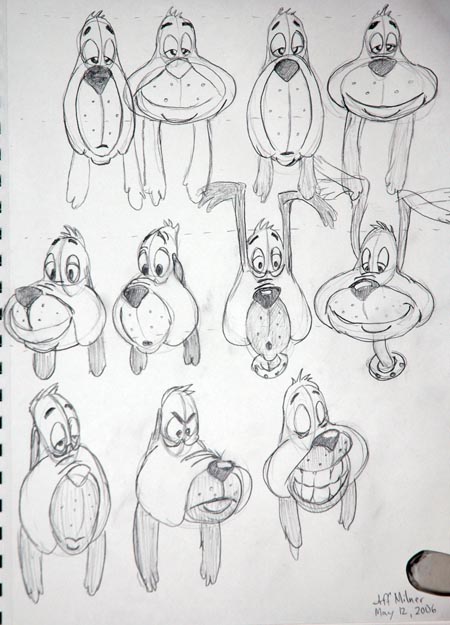
Here is my page of drawings from John Kricfalusi’s Preston Blair animation lessons: Lesson 2 – Squash and Stretch:
John Kricfalusi writes:
You can go to animation school, spend a $100,000 and not learn a damn thing about the basics of good animation drawing-OR you can buy a Preston Blair book for $8 and learn it all in a couple months. You pick.
Just about every cartoon being made today is based on the principles and style of cartoons made in Hollywood in the 1940s—Anime, Cartoon Network flat stuff—even the Simpsons. The only difference is, that some of the principles that make the classic stuff look so good have been lost. The new cartoons are all a degeneration of what cartoons once were—a superficial copy of them—even though many off the artists drawing today don’t even know they are copying—but copying wrong—styles and trends and principles of what developed from the animated cartoons of the Golden Age.
John feels that one of the best ways to learn is by studying master animator Preston Blair’s book, “Animation”.
I’m going to not only tell you about the Preston Blair Book—but I’m gonna guide you through it, fundamental concept by fundamental concept.
I decided to take a whirl at the first lesson, by drawing the cartoon characters from the book. Here are my first drawings:
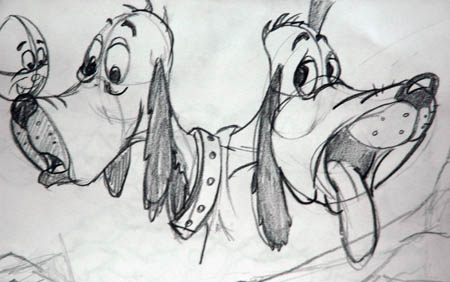
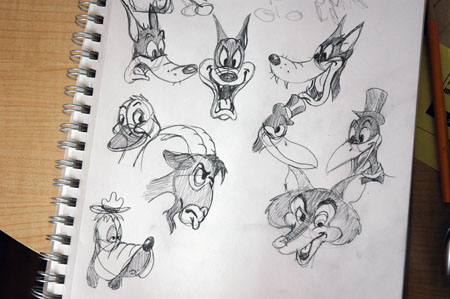
If you’re up to it, you can give the first lesson a try too. It’s easy when you follow the instructions.
Steve Rubel’s post, 25 Things I Learned on Google Trends is a fun look into world search trends using the new Google Trends.
What I enjoy is not only what search trends are developing, but how one search item compares with another. Seeing where the less politically correct searches are popular is also extremely interesting.
Sex is obviously a lot more popular than drugs for searches, but it’s mentioned just about as often in the media—rock and roll almost doesn’t even register. Cairo, Egypt gets the award for searching for “sex” most often with most of those searches being done in Arabic. Prostitution, however, is most searched for in Montreal.
Backmasking is most searched for in Melbourne, Australia, and it’s hard to say for sure, but it looks like it had a spike in January when the Wall Street Journal did that story about it, and again lots of other spikes as other big organizations and networks picked up the story.
Pepsi appears more popular than either term—Coke or Coca-cola, and Yahoo is still more popular than Google but they’re closing the gap.
Here is a list of new changes coming to Flickr.
(Via FlickrBlog)
I’m counting the days before I head off to Québec City for the five weeks of intensive courses in French as a foreign language. I’m extremely excited and have been hitting the Speak and Read Essential French MP3’s extra hard lately.
I’ve also been reading up on the 1759 Battle for Québec. I find early Canadian history so rich with action and excitement, I love to read all about it! We’ve got our fair share of stories that would make brilliant blockbuster movies, allow me to share this one and let me know what you think.
The odds were stacked against New France. The British outnumbered the French three to one in ships, four to one in troops, and the Brits had a ten to one advantage in money.
I’ve been checking out Google maps to try and figure out where the attack must have happened. As the story goes, the British sailed down the St. Lawrence with more than 140 ships (one full quarter of the British Navy) and were spread over a distance of 50 miles. James Wolfe, the English General, had also in his command over 13,500 men — 9,000 of whom were from the best units in Britain.
It was the best trained and equipped army North America had seen, supported by the biggest and best fleet.
-popular historian Gordon Donaldson
However, conquering Québec City, “the Gibraltar of the New World” was not an easy task, and Wolfe soon discovered that despite his huge advantage there wasn’t really any way to get beyond the city’s fortified walls. Louis-Joseph de Montcalm, the French general, was misinformed by native-born Canadien and governor Pierre de Vaudreuil’s engineers that the English cannons did not have the range to reach them over the huge St. Lawrence River, and so didn’t reinforce the southern shore. In this they made a grave mistake.
Determined that he would wear the French down by sheer persistence, Wolfe ordered his cannons to pound the city for months killing civilians and destroying homes by the score. The prolonged destruction served no real military purpose other than to terrorize and demoralize the city’s inhabitants.
Summer turned to autumn and still Wolfe had not taken the fortified city. Time was beginning to run out for Wolfe, and he began to worry how he would explain to England why the attack was taking so long. He decided to try a new strategy.
Earlier, [Wolfe] had spotted a break in the cliffs west of the city, at a cove called l’Anse-au-Foulon. If [he] could somehow land his men undetected and then scale the cliffs, he might be able to put his army on the plains behind the city and draw Montcalm out into the open . . . and so it was, on a moonless night in mid-September, that a flotilla of 30 flat-bottomed boats slipped silently downriver with the tide.
On September 13, 1759, after bluffing their way past a French Sentry, an advance guard climbed the narrow trail and overpowered the French post at the top. The rest of the troops followed soon after pulling themselves onto the Plains of Abraham and by daybreak more than 4,500 English troops assembled on the far side of the City.
The surprise was complete. General Montcalm had been convinced that the final attack, if it came, would be on the other side of the city at the Beauport shore. When an aide suggested that the British might try to climb the cliffs, Montcalm had snorted with derision. “We do not need to imagine that the enemy has wings,” he wrote in his journal, “so that in one night they can cross the river, disembark, and climb the obstructed cliffs.” But now, they had done just that. As he hurried to assemble his troops, Montcalm looked out at the redcoats that were lining up behind the city, and complained, “They have no right to be there.”
Wolfe had managed to drag up only two light cannons. Montcalm decided that time was of the essence and that the British had to be attacked immediately, before they could dig in and strengthen their position. For the first time since the British arrived, Montcalm acted impulsively. He had 3,000 reinforcements somewhere behind the British lines—a message had been sent and they were on their way—but he didn’t wait for them to arrive. Instead, Montcalm gathered the troops he had on hand and threw open the city gates . . .
The battle lasted only 15 minutes. The British had formed a “thin red line,” two men deep, and the French advanced in a ragged charge, the regulars and the Canadiens stumbling over each other. Native snipers were picking off British soldiers from nearby woods, but Wolfe stood his ground. Then, when the French were only 30 paces away, the order was given. The redcoats raised their muskets and fired, one platoon after the next in rolling thunder across the Plains. Smoke filled the battlefield. The British re-loaded and advanced, emerging from the smoke like ghosts. They fired a second volley, and that was all it took. The French broke and ran.
Both Wolfe and Montcalm were killed due to injuries suffered in the battle, Wolfe on the Plains and Montcalm within the city walls. The two sides had each taken roughly the same number of losses, 650 each, and the British hadn’t really won anything of consequence, it was just a field, and in fact not a particularly safe one, but all the same the French were rattled.
The British had won a field. That was it. If anything, they were in a dangerously exposed position. Québec fell not because the British won, but because the French lost their nerve. Vaudreuil panicked and fled with his troops along a side road. Five days later, the city’s bewildered commander (who had been left behind without any clear instructions) surrendered the city. The Canadiens hadn’t been conquered by the British: they had been abandoned by France.
I’m in Medicine Hat for the weekend. I guess I should mention, I was totally non-plussed to see the Flames lose in game seven to The Mighty Ducks last night—’nuff said.
However, last weekend was a little more exciting. I went to visit a friend in Calgary, watched the Flames game where they actually won, and then had a job interview on Monday morning that went spectacularly well. (Some extenuating circumstances may prevent me from being available to actually take the job, but the interview was great).
For those of you that have never been in a hockey town during playoffs, let me take a moment to describe the experience. Calgary is a booming town and as such traffic has taken on a new level of horror. I understand even the life-long Calgarians, many of whom were born in traffic jams on their way to the hospital (and as such are used to bad traffic), have been complaining about how unbearable it’s gotten.
But when the hockey game starts the streets clear out. Everyone sits on the edge of their seats, glued to their TVs. At a moments notice the entire city jumps to its feet and makes a collective cheer as one of the Flames scores. Those brave few souls that venture out of their homes to refill their beverage/junk food collections will be notified of any goals via cars honking and people cheering from their homes. It can feel pretty disappointing if you happen to miss a goal, but all the same, its exciting to hear the reaction of so many people around town.
Watching the game anywhere would have been entertaining but we had a particularly fun evening lined up watching it on the roof of a building in downtown Calgary only a few blocks away from the Saddle Dome. And if all that weren’t enough, two of the people attending were also celebrating their birthdays! It was a perfect setup for a great night, so needless to say, a great time was had by all.
That was, until somebody discovered they had imbibed just a little too much wine just a couple of glasses too late.
You’re probably wondering if that someone was me, and the answer is no… luckily for me, The Universe was turning its wrath on someone else. But it meant that going down after the game to enjoy the festivities on 17th Ave (or Red Mile) was out of the question and I missed seeing the 18,000 fans stumbling into one another giving each other hugs, and spilling their drinks on each other, and telling complete strangers how much they loved each other, in celebration of the win. Instead I caught an independant private cab (what some would have described as a sketchy unmarked gypsy cab) back to the place I was staying for the night. Meanwhile my friend gripped onto the homemade puke bucket in the back seat hoping not to have to use it. Oh the adventure!
When we got to the place I quickly setup the futon for myself and was about to get her into her friends bed when I was surprised to hear her say she wanted to sleep on the futon beside me, and of course she wanted her trusty bucket nearby too. I got her all wrapped up in a blanket and pillow and laid her down to sleep.
As the moment just before I drifted off arrived; I looked over at my platonic friend and contemplated on what a fun time we’d had. The cheering as the Flames won, the yelling down from the top of the building at the happy fans as they made their way to the Red Mile and the all around unifying force that only a home town win can bring. Despite the evening being cut short, what I really liked most was how good it felt to have someone to take care of again, even if it was only for one night. It’s moments like that, where I can make someone feel just a little bit better, that make me most happy to be alive. Oh and of course the Flames winning was a nice bonus.
