The Amazing Intelligent Resize

Currently if you have a large image that you need to make smaller for the web you can either scale it or crop it. Scaling makes everything smaller and cropping can cut out important content. This incredible video demonstrates an image re-sizing algorithm that is content-aware. It’s pretty cool and I figure it’s something that is going to make someone a boatload of money.


[Content Aware Image Sizing – YouTube]

Platform

Platform

Just for fun, the motion graphics fans out there might enjoy the stop action magic of Platform from motiongrapher.com.

“Smith & Foulkes used a Canon Digital SLR camera linked up to a laptop allowing them to capture frames and play them back checking the shots as they went along. By shooting digitally Smith & Foulkes ended up with a much larger image size to work with when compared with the normal 35mm motion picture frame. These frames were then taken into After Effects and Photoshop for a clean-up where people and rigs from shots were removed. A final grade was then added in Flame.”

TED Talk by Blaise Aguera y Arcas

What you are about to watch is truly remarkable, and it just gets better as it goes.

Using photos of oft-snapped subjects (like Notre Dame) scraped from [Flickr], Photosynth (based on Seadragon technology) creates breathtaking multidimensional spaces with zoom and navigation features that outstrip all expectation. Its architect, Blaise Aguera y Arcas, shows it off in this standing-ovation demo.

See more on Seadragon and Photosynth.

Typographics

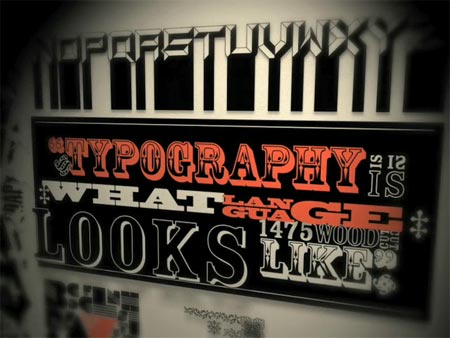
Ryan Uhrich, an artist living in Edmonton, AB has created a wonderful motion graphics piece called Typographics (19mb Quicktime).

Typography Motion Graphics

I love watching this kind of thing and wish I was more experienced with compositing.

Karleb Homes Ltd Website

Karleb Homes Ltd. LogoI just finished putting together a site for a small construction company in Drayton Valley, Alberta, Karleb Homes Ltd.

Using cascading style sheets (CSS) I was able to keep the “content” of the site separate from the design. I also used Douglas Bowman’s sliding door technique for the navigation tabs which allows greater accessibility for larger fonts and screen readers than say just using regular, old-fashioned rollover images.

The footer is actually a repeat of the top menu, placed at the bottom of the screen because that’s really where the user needs it most—ie. at the end of the page ready for when he or she is done reading. For the spacing of the fonts, I relied on Richard Rutter and Mark Boulton’s SxSW talk, Typography for the Web.

I took the photos inside Karleb Homes’ newest project. I used my sister’s brand new Canon 5D as well as two of her Alien Bees lighting kits. The yard in the photo used for the header hasn’t been landscaped yet, but will be replaced when the landscaping matches the quality of the house.

I’m very pleased with the outcome of the site and I look forward to the making the next one—I love creating nice, friendly, and accessible websites and I’m currently looking for more opportunities, so if you are in need, let me know.