What would life look like if there were no god?
[What if God Disappeared – YouTube]
What would life look like if there were no god?
[What if God Disappeared – YouTube]
The BeliefOMatic matches your stated beliefs with a corresponding set of beliefs.
Even if YOU don’t know what faith you are, Belief-O-Matic™ knows. Answer 20 questions about your concept of God, the afterlife, human nature, and more, and Belief-O-Matic will tell you what religion (if any) you practice or ought to consider practicing.
My top three were:
I took it before and had a higher “Non-theist” score, but this time I answered some of the questions based on what I thought was right, instead of marking them all “not applicable”.
Since the introduction of open lectures by progressive thinking educational institutions like M.I.T., Stanford, Duke, Yale, and others, many exceptional presentations have bubbled to the top and should be watched.
Here are five must see open course video lectures as recommended by Virginia Heffernan of the NYTimes.
I also recommend Mark Schlissel, Introduction – The Cell Theory, Bacteria, Animal Cells, Evolution (Viruses and Midochondria). (The good stuff starts at about 13:00).
I listened to about a quarter of all the lectures from this course—most of which were over my head, but the first and second (mp3) classes are fascinating and make me wish I studied biology at school.
The documentary, The Qur’an, portreys Islam and its many forms, cultures, and backgrounds. The director, Antony Thomas, made waves in the Muslim world nearly 30 years ago with his documentary, Death of a Princess, a program based on the beheading of a Saudi princess and her adulterous lover, which, when broadcast by an ITV company in 1980, caused canceled contracts and threats of retribution from the Saudi rulers. It has never been re-broadcast.
Within “The Qur’an”, we see highly educated people bearing witness greater richness of their lives once they had allowed the message of the Koran into their hearts. We also see how multiple interpretations of the holy book coupled with violent extremism clashes not only with the non-Muslim world, but also within Islam itself.
Aired: July 14, 2008 on Channel 4 A ground-breaking, feature-length documentary by award-winning film maker Antony Thomas, The Qur’an asks what Islam’s holiest book actually says about issues such as equality, punishment, peace, other faiths and suicide bombing. The film is part of a special week of powerful and thoughtful programmes that aim to de-mystify, as well as celebrate, the world’s most talked-about religion and offer an insight into the lives and beliefs of Muslims across the globe. Warning: The Program contains footage of executions, the aftermath of bombing and female genital mutilations which may upset some viewers.
Running time of 1:41:32.
[The Qur’an – Google Video]
The embedded video is down. See Channel 4’s site for more information about The Qur’an documentary.
Last September, four of the world’s most famous sceptics, Richard Dawkins, Daniel Dennett, Sam Harris and Christopher Hitchens gathered together for a first-of-its-kind, unmoderated 2-hour discussion on religion, belief, and scepticism.
After several setbacks (including the Writer’s Strike) comedian Bill Maher’s new documentary, Religulous, will be released in theatres October 3rd, 2008. Known for his stance against religion, Bill Maher’s views on the various world religions are explored as he travels to numerous religious destinations, such as Jerusalem, the Vatican, and even Salt Lake City. He interviews believers from a variety of backgrounds and groups, including Jews for Jesus, Muslims, polygamists, Satanists, Hasidic scholars and even Rael of the Raelian Movement.
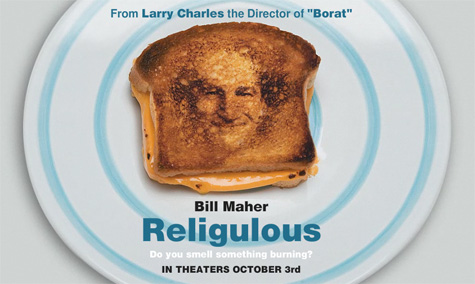
From a Variety story on Religulous:
Explaining his impetus to make the film, Maher said: “I wanted to make a documentary, and I wanted it to be funny. In fact, since there is nothing more ridiculous than the ancient mythological stories that live on as today’s religions, this movie would try to be a real knee-slapper. Unless, of course, you’re religious; then you might not like it.”
A trailer for Religulous, is online at Apple. (Also on YouTube)
In 1707, a biblical theologian named John Mill was the first to collect and combine the text of some 100 extant New Testament manuscripts. After 30 years of study he noted over 30,000 various major to mostly slight errors in the different versions of the New Testament manuscripts. His discovery brought to light the fact that so many different versions of the New Testament exist and that the book many people think of as the immutable word of God has an uncomfortably long history of changes.
The following video lecture is a tremendously interesting look at some of the discrepancies by world renowned bible scholar and author Dr. Bart D. Ehrman.
“There are places where we don’t know what the authors of the New Testament wrote. […]
The problem of not having the originals of the New Testament, though, is a problem for everyone—not simply for those that believe that the bible was inspired by God.
For all of us, I think, the bible is the most important book in Western Civilization. It continues to be cited in public debates over gay rights, abortion, over whether to go to war with foreign countries, over how to organize and run our society. But how do we interpret the New Testament? It’s hard to know what the words of the New Testament mean, if we don’t know what the words were.
And so in this lecture I’ll be talking about not knowing what the words were and what we might know about the originals of the New Testament, how they got lost and how possibly they might be reconstructed.”
[Misquoting Jesus| Youtube]
Richard Dawkins takes a stab at why we’re here, using science and reason to back up his answer. It’s an interesting and inspiring perspective on an old question.
[The Big Questions – YouTube]
I’ve talked about Richard Dawkins’ documentary The Root of all Evil before, but something I came across the other day which I found very interesting is The Big Picture: Debate on Dawkins’ Root of all Evil.
(Coincidentally my friend Shannon Phillips is one of the producers on Avi’s other show, On The Map.)
A recently released Gallup Poll indicates that more Americans accept theory of creationism than the science of evolution.
I have to ask myself, is it because those pesky scientists have been wrong about so many things or because religion has been so particularly good at teaching us about the way the world is?
The data from several recent Gallup studies suggest that Americans’ religious behavior is highly correlated with beliefs about evolution. Those who attend church frequently are much less likely to believe in evolution than are those who seldom or never attend.
I’d be interested if there is also a correlation between those that finish high school and those that trust the science behind the theory of evolution, and again between those that go on to University and if they believe in so called “intelligent design” or evolution.
The data indicate some seeming confusion on the part of Americans on this issue. About a quarter of Americans say they believe both in evolution’s explanation that humans evolved over millions of years and in the creationist explanation that humans were created as is about 10,000 years ago.
Quite frankly, no matter which side of the debate you take, you have to admit the data indicate that about a quarter of Americans are stupid.